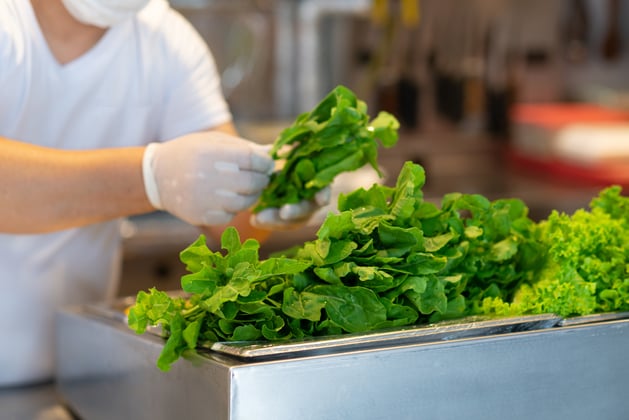
As foodborne illness investigations and food recalls put renewed attention on the food supply chain, restaurants face a critical question — Can they trace an affected ingredient, act quickly, and reassure their guests?
It has been a busy summer for food safety.
Cyclospora, a microscopic parasite that causes gastrointestinal illness, has emerged as one of the year's biggest foodborne illness stories.
Since May 1, the CDC has recorded more than 18,000 laboratory-confirmed cases of domestically acquired cyclosporiasis — far more than during the same period last year. A large multistate outbreak linked to processed iceberg lettuce from central Mexico has contributed significantly to the increase.
Cyclospora isn't the only reason restaurants have had to pay attention. A salmonella outbreak linked to fresh jalapeños from Mexico has sickened more than 400 people across 32 states. Of those interviewed by investigators, 91% reported eating at a Mexican-style restaurant before becoming ill, underscoring how quickly an ingredient-level issue can become a restaurant-level concern.
Meanwhile, a multistate listeria outbreak linked to soft cheese resulted in 15 illnesses, with 14 hospitalizations and one death. The recalled products moved through distributors to restaurants and retailers in multiple states, adding another layer of complexity to the recall process.
The individual outbreaks are different. The operational challenge is remarkably similar.
When an ingredient is implicated in a foodborne illness outbreak, a restaurant needs to answer a deceptively simple question — Do we have it?
And answering that question can quickly require much more than checking a walk-in.
The Summer's Bigger Food Safety Story
It would be easy to look at the headlines and conclude that foodborne illness is simply becoming dramatically more common.
The reality is more complicated.
The CDC's FoodNet surveillance shows that infections reported in 2024 were either higher than or similar to the 2016–2018 baseline for the pathogens it monitors.
At the same time, the CDC notes that the use of culture-independent diagnostic tests, or CIDTs, continues to increase. The increased use of these tests can help identify infections that might previously have gone undetected.
So while some pathogens are showing increased incidence, the bigger picture is not as simple as saying there are suddenly more foodborne illnesses everywhere. We're also getting better at finding, investigating, and connecting cases.
And that distinction matters for restaurants. Regardless of why an outbreak occurs or how quickly public health agencies identify it, operators still have to be ready to act when a food safety alert reaches their door.
For restaurants, the question isn't simply whether the number of alerts is rising.
It's whether they're prepared for the next one.
The Questions Every Restaurant Needs To Answer
A recall notice might identify an ingredient, supplier, lot number, or date range.
But the restaurant has to translate that information into its own operation.
- Where was the product received?
- Which location received it?
- Is it still in inventory?
- Was it used in a sauce, dressing, or other prepared item?
- Which recipes contain it?
- Which menu items contain those recipes?
- Was it sent to another location?
- Was it used for catering?
- Was it already served?
And, perhaps most importantly — has every person who needs to take action actually done so?
Avoiding Breakdowns
Marylise Trépanier, a Back of House consultant, identifies traceability and communication as two of the biggest places restaurants can break down when responding to a food-safety alert.
“First, they may not be able to quickly determine where the affected ingredient was stored, which recipes it was used in, or which guests may have received it,” she says. “Without proper tracking, the response becomes slower and less precise.”
That is the difference between having a recall notification and having food traceability.
A restaurant that can trace an ingredient by receiving date and lot number may be able to isolate the affected product while leaving unaffected inventory in service. That can protect guests while avoiding unnecessary waste.
Consider a catering operation delivering food to multiple locations. If a lettuce recall affects one lot received last week but not another lot received this week, the operator needs to know the difference. Without that information, the safest operational decision may be to discard everything.
With granular food traceability, the response can be much more targeted.
From Recall Alert to Action: Turning Food Safety Information Into a Response
This is where food safety technology can move from being another digital dashboard to becoming an operational tool.
The goal isn't simply to digitize paperwork. It's to connect information that traditionally has been scattered across:
- Purchasing records
- Receiving logs
- Inventory sheets
- Recipes
- Production records
- Employee checklists
Ideally, a restaurant should be able to move through something like:
Supplier → receiving → lot → inventory → recipe → menu item → location → employee action → documentation
When those connections exist, an alert can become an actionable workflow rather than a research project.
The Importance of Trackability
Marylise points to ingredient-level tracking as an example. Systems such as NutraSoft can connect an ingredient with its location, the recipes in which it is used, and orders or deliveries associated with it.
“When you receive a recall alert and immediately can export the complete journey of that specific item, it saves time, prevents headaches, reduces financial losses, and protects your reputation,” she says.
That same principle applies to everyday food handling, not just major food recalls.
In high-volume kitchens, prepared foods such as sauces can be produced, moved, and stored repeatedly. Handwritten labels can become damaged by grease, frost, or condensation, making it harder to determine when something was produced or how long it remains safe to use.
Marylise points to digital labeling and production-tracking tools as one way operators can make that process more reliable. Depending on the system, operators can:
- Record production dates and quantities as food is prepared.
- Print durable labels that are easier to read and maintain than handwritten ones.
- Track shelf life and expiration dates as prepared foods move through the operation.
- Alert employees when an item is approaching its expiration or discard date.
- Create searchable records that can be referenced during a recall or inspection.
- Quickly demonstrate documentation around inventory, preparation, cleaning, and temperature monitoring.
The result is more than a digital replacement for a handwritten label. It creates a record of what was produced, when it was produced, and what happened to information that’s especially valuable when an operator needs to respond quickly.
Technology Can't Replace Judgment
Automation can make a recall response faster, but it shouldn't eliminate human oversight.
A system can identify potentially affected products, surface the locations that received them, assign tasks, and document that those tasks were completed. But someone still needs to determine what the information means and what action is appropriate.
That human element is where training becomes just as important as technology. Training remains a fundamental part of food safety, particularly in an industry where employees are constantly receiving, preparing, storing, and serving food.
That distinction matters because food recalls aren't always simple. An operator may need to account for:
- Multiple lot numbers for the same product
- Ingredients used in other prepared products
- Recalled items that have already been discarded
- Updated information from a supplier or distributor
- Differences between the restaurant's records and distributor records
The more variables involved, the more difficult it becomes to determine exactly what needs to happen — and the more valuable clear, connected records become.
You Need a Plan
Trust20, an ANAB-accredited provider of food handler, food allergy, and food protection manager training, emphasizes the importance of giving food service employees clear, practical steps to follow when a recall occurs.
Those steps include:
- Identifying and separating recalled products from safe inventory.
- Cleaning and sanitizing areas where recalled products were stored or prepared.
- Clearly labeling recalled items so they cannot accidentally return to inventory.
- Communicating the recall to the entire team, not just employees who initially receive the alert.
- Following return or disposal instructions provided by the supplier or recall notice.
Bethany Zak of Trust20 stresses the importance of communicating recalls across the team. “Don’t rely on labels alone!” she says. “Inform your team not to use the products verbally, via email, etc.”
Food Safety Is Also a Communication Problem
There is another side to recall preparedness that doesn't appear on an inventory report — trust.
An operator can have excellent traceability and still damage a brand if communication is slow, noncommittal, or confusing.
Marylise says restaurants sometimes make the mistake of minimizing or hiding an issue.
“That often creates more damage than the alert itself,” she says. “Being honest, taking responsibility, and clearly explaining what actions are being taken are essential to maintaining trust.”
The basic communication framework is straightforward:
- Identify the affected product and relevant dates or lot information.
- Explain that the product has been removed or otherwise addressed.
- Communicate what additional safety measures are being taken.
- Equip employees with accurate information so guests receive consistent answers.
For guests who believe they may have consumed a recalled product, restaurants should direct them to the relevant public health or recall guidance rather than attempt to diagnose an illness themselves.

Subscribe to Our Weekly Back of House Newsletter
Short and sweet summaries for busy restaurant operators. Subscribe to the Back of House newsletter to get updates delivered straight to your inbox.
Bethany of Trust20 recommends a simple approach. “Employees should listen to their concern, don’t guess, and verify the facts before responding,” she says.
She also outlines what not to say. Employees should avoid statements such as:
- “I’m sure it’s fine.”
- “Cooking kills it, so there’s nothing to worry about.”
- “We haven’t heard anything about it.”
- “Our food is completely safe.”
The objective isn't to create unnecessary alarm. It's to demonstrate that the restaurant knows what happened, knows what it's doing about it, and is willing to communicate honestly.
The Supply Chain Is Part of the Food Safety System
Restaurants aren't dealing with these alerts in isolation.
The recent outbreaks demonstrate how many hands can be involved between an ingredient's source and the guest's plate.
In the cyclospora investigation, federal and state officials used patient interviews, traceback, and other evidence to connect illnesses with iceberg lettuce from central Mexico.
The CDC notes that investigators often face additional complexity because foods under investigation may contain multiple ingredients, and cyclospora is more difficult to track genetically than pathogens such as salmonella.
The salmonella investigation offers another illustration. The FDA says the implicated jalapeños were distributed to wholesalers and restaurants, while downstream recalls affected products containing the recalled peppers.
Foodservice distributors therefore play an important role in the chain between supplier and restaurant.
Gordon Food Service, for example, describes a quality-assurance program that spans several stages of the supply chain, including:
- Supplier qualification and audits
- Distribution-center food-safety programs
- Recall notification and incident handling
- Customer-facing food-safety assurances
Those systems are an important part of the chain, but no distributor can substitute for the restaurant's own operational visibility.
The restaurant still needs to know what it received, when it received it, where it went, and how it was used. That is where supplier-side processes and restaurant-side food traceability have to meet.
The ROI Isn't Just Preventing a Bad Day
For restaurant operators, investing in food safety technology can be difficult to justify because the best-case scenario is often that nothing happens.
There is no dramatic return on investment for the recall that never affects you.
But that is also the point.
“One serious food-safety incident can quickly destroy a business,” Marylise says. “That's why ROI shouldn't be measured only in dollars or short-term savings.”
The value of food safety technology can show up in several ways:
- Protecting guests by helping operators respond quickly to potential risks
- Limiting the scope of an incident through faster, more precise traceability
- Reducing unnecessary food waste by identifying exactly which products or lots are affected
- Saving employee time by making records easier to find and act on
- Supporting regulatory compliance with accessible, organized documentation
- Protecting the restaurant's reputation by enabling a faster, more transparent response
“Food-safety technology isn't simply an expense,” Marylise says. “It's a form of risk management that helps keep the business operating.”
In other words, the ROI isn't necessarily what a restaurant saves on a normal Tuesday. It's what it stands to protect when something goes wrong.
You Can't Prevent Every Alert. You Can Prepare For It.
The Summer of Cyclospora delivered a reminder that restaurants operate within a food system larger and more interconnected than any individual kitchen.
A contaminated ingredient can move through a complex supply chain. A laboratory test can connect illnesses across states. A recall can evolve as investigators learn more. And a restaurant may have only a short window to determine whether an affected product is sitting in its inventory, or has already become part of a recipe, order, or guest experience.
The answer isn't to assume that every recall signals a failing food system.
It is to recognize that food safety increasingly depends on how quickly information can move through the system, and how effectively restaurants can turn that information into action.
The strongest operators won't necessarily be the ones that never receive a food-safety alert. They'll be the ones that, when the alert arrives, can answer:
What do we have? Where did it go? What do we need to do? And how do we know we've done it?
As Marylise puts it, “You can't prevent every food-safety alert. But you can make sure you're prepared for the moment one arrives.”
Build a Stronger Food Safety Foundation
Food-safety preparedness starts with the right systems, but it depends on the people using them.
For restaurants looking to strengthen employee knowledge and build a culture of food safety, Trust20 offers online food handler, food allergy, and food protection manager training designed to help food service teams understand the risks and respond with confidence.