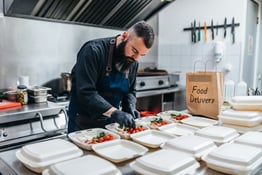
A restaurant can have great recipes, talented chefs, and a carefully designed menu. But none of that guarantees that the dish arriving at a customer's table will be presented or portioned as intended.
That gap between what a restaurant expects to serve and what actually leaves the kitchen is where plating consistency becomes both a customer experience issue and a business issue.
For Matt McKenna, co-founder of FooQai, the idea started with a simple observation. While helping his wife, who owns and operates a restaurant, Matt began thinking about a plate of food differently.
“What if we could look at this plate of food like data?” he recalls thinking.
The more he considered it, the more obvious the opportunity became. A plate isn't just the final expression of a chef's work. It also contains measurable information:
- How much food is on it
- How many components are present
- How those components are arranged
- Whether the finished presentation matches the restaurant's standards
That perspective is at the heart of FooQai's PlateScan technology, which uses computer vision to analyze finished plates and measure elements such as portioning, item count, arrangement, color, and cleanliness against a restaurant's defined standards.
It points to a larger operational challenge facing restaurants today — how do you consistently measure what is actually leaving the kitchen?
Small Inconsistencies Can Become Big Costs
Restaurant margins are famously sensitive to small changes. An extra ounce of protein might not seem significant on a single plate. Neither does an additional side, a portion that gradually creeps upward, or a component that is occasionally missing.
The problem is repetition.
“The most common issues are usually not dramatic mistakes,” Matt says. “They are small variations that happen repeatedly.”
Those variations can include:
- Portions running heavy
- Inconsistent item counts
- Missing components
- Presentation slowly drifting away from the intended standard
Individually, those discrepancies may be easy to overlook. Across hundreds of plates, multiple shifts, and multiple locations, they can add up to meaningful food-cost variance and directly affect restaurant profitability.
Small Variations Add Up
One PlateScan analysis illustrates the point.
In an examination of just 50 plates at a multi-location barbecue concept, FooQai identified approximately 4.6 pounds of excess portioning — roughly 1.5 ounces per affected plate.
That translated to about $36 in excess food cost across those 50 plates, showing how small portions can add up quickly when the same variation repeats across a restaurant's operation.
No individual plate necessarily looked dramatically wrong. The pattern became apparent when the plates were considered collectively.
Restaurant operators don't necessarily need to find one enormous mistake. They need visibility into the small deviations that happen often enough to affect the business.
The Customer Sees the Plate Before the Restaurant's P&L
But the impact of consistency goes beyond food costs. Before a guest tastes a dish, they see it.
“You eat with your eyes before you trust to put it in your mouth,” Matt says. “If something just doesn’t look right, it gets your attention.”
That moment matters because a restaurant’s presentation is part of how a guest experiences the brand. Over time, the look and presentation of a signature dish can become part of what customers recognize about a restaurant.
When those details change from one visit to the next, the guest may not be able to explain exactly what feels different. But they notice. And that can influence what they order the next time they visit.
Consistency Shapes the Guess Experience
A customer who has had an inconsistent experience with one dish may simply choose something else they know the kitchen executes reliably. The restaurant may never hear a complaint or realize that inconsistency changed the customer's behavior.
For Matt, that's why getting the plate right every time is about much more than presentation.
“If you get the plate right, that means operationally you've trained people, you have the right economics on the plate, you have the right vision and the clarity of vision, and you're executing it to your consumer,” he says. “That to me is the only way that business sticks around.”
In other words, plating consistency connects the kitchen to the customer in ways that extend well beyond appearance. It helps:
- Protect the economics of the dish
- Preserve the chef’s vision
- Give the customer a reliable experience every time they order it
That makes consistency a business standard, one that can affect restaurant profitability and the customer experience at the same time.
Consistency Gets More Difficult as Restaurants Grow
Maintaining that expectation is challenging enough in a single kitchen. It becomes even more challenging across multiple locations.
Every additional restaurant, shift, manager, chef, and employee introduces another opportunity for variation.
Restaurants generally aren't lacking standards. They may have recipes, photographs, training materials, portion specifications, and established plating procedures. The challenge is knowing whether those standards are actually being followed consistently.
A photograph on the wall can show employees what a finished dish should look like. It can't tell an operator whether today's plates are consistently matching that standard.
That becomes particularly difficult when staffing changes.
Growth Creates More Opportunities for Variation
“Restaurants are constantly bringing new kitchen staff into the business while others move on,” Matt says. “That puts immediate pressure on owners, kitchen managers, and, for larger enterprises, regional teams to communicate clear expectations and maintain consistency.”
And the larger the organization, the bigger the blind spot becomes.
As Matt puts it, a problem at a small independent restaurant and the same problem at a large restaurant group are fundamentally the same issue. “All you have to do is just add more zeros to magnify the business problem and the impact on the profit and loss [P&L].”
From Subjective Feedback to Measurable Coaching
Another benefit of measuring execution is that it can change how kitchen teams are coached.
Anyone who has worked in a professional kitchen knows that feedback can be highly immediate and highly subjective.
One chef may have trained a cook to plate a dish one way, while another experienced employee suggests a shortcut. During a busy service, corrections often happen in the moment, under pressure, with little opportunity to explain exactly what went wrong or determine whether the issue is part of a larger pattern.
Data Gives Teams a Common Standard
Instead of telling an employee that a dish “doesn't look right,” an operator can identify where execution is drifting and coach against a defined standard.
Matt sees this as a fundamental shift in the conversation.
“It's no longer that you did it wrong,” he explains. “It's how do we correct it together?”
That distinction can matter for both training and culture. The goal isn't to replace the expertise of chefs or managers. It's to give them better information with which to use that expertise.
STAY IN THE KNOW
Short and sweet summaries for busy restaurant operators. Subscribe to the Back of House newsletter to get updates delivered straight to your inbox.
And importantly, not every plate needs to be identical.
Restaurants need to define what acceptable variation looks like for their particular concept. A fine-dining restaurant, a barbecue restaurant, and a fast-casual concept may have very different priorities.
FooQai's approach allows restaurants to calibrate the characteristics that matter to their brand, including elements such as:
- Portion
- Arrangement
- Color
- Cleanliness
- Item count
The objective isn't perfection. It's knowing what the acceptable range is, and knowing when execution is consistently moving outside of it.
Why Continuous Measurement Changes the Equation
Traditional quality checks provide snapshots.
A manager or food expeditor might inspect a few plates during a shift, visit a location, or respond to a customer complaint. Those checks can identify problems, but they don't necessarily reveal how frequently an issue occurs or where it originates.
From Periodic Checks to Continuous Visibility
Continuous measurement creates a different kind of visibility.
“Periodic quality checks give you moments in time,” Matt says. “Continuous measurement gives you the operating system of the kitchen.”
That visibility can connect execution to the rest of the restaurant's operational data.
Restaurants already have systems that tell them what was sold, what ingredients were purchased, how much inventory they have, and who worked a particular shift.
Historically, however, there has been much less objective information about the final step — what actually left the kitchen.
That's the gap FooQai is addressing with what it describes as an “execution data layer” for kitchen operations.
The significance goes beyond plating. Once execution becomes measurable, operators can begin identifying patterns across:
- Menu items
- Shifts
- Stations
- Teams
- Locations
A regional manager can see that portions have been trending low at one location. A chef can identify a dish that consistently misses its presentation standard. A team can receive targeted training and then be measured again to determine whether execution improved.
The conversation moves from anecdote to evidence.
Better Execution Connects the Kitchen to the Customer
The value of measuring execution is that it gives operators:
- A clearer view of what is happening on the plate
- Better visibility into where problems are occurring
- Information they can use to determine what needs to change
As Matt puts it, “Now we're able to look at this data and say with absolute certainty we can see what is going out of our business and how do we correct it to become more profitable, better tuned, better repeatable, and better customer satisfaction.”
That's the larger opportunity behind measuring kitchen execution. The goal isn't simply to make plates more consistent. It's to make kitchen execution measurable enough to improve.
Making Kitchen Execution Measurable
For restaurants operating under constant pressure from food, labor, and other costs, that visibility can become another lever for improvement. Operators already have data telling them what they sold and what they spent.
The next question is no longer whether consistency matters. It’s whether restaurants can see where it breaks down and act on it.
Want More Restaurant Operations Insights?
Running a restaurant means making hundreds of decisions every day, from controlling food costs and maintaining consistency to training teams and delivering a better customer experience.
For more practical insights on restaurant operations, technology, and strategies for running a stronger business, subscribe to the weekly Back of House newsletter. You’ll get expert insights, actionable ideas, and resources delivered straight to your inbox.