Restaurant revenue growth today is no longer about choosing between on-premises and off-premises strategies. On-premises revenue comes from guests dining in your restaurant, while off-premises revenue includes restaurant takeout and delivery sales, curbside pickup, and other ways customers enjoy your food beyond your four walls.
The real opportunity lies in how effectively operators integrate both into a single, connected system.
What I’ve been seeing across the industry, reinforced by the latest 2026 State of the Restaurant Industry insights from the National Restaurant Association, is a clear shift in how consumers engage with restaurants.
Consumers still value dining out, but increasingly they expect that experience to extend beyond the table and into their homes, routines, and digital lives.
That fundamentally changes the conversation around how to increase restaurant revenue, expanding what counts as a revenue-generating interaction.
Strengthening On-Premises Restaurant Revenue Through Experience-Led Dining
On-premises traffic remains uneven, but I don’t interpret that as a decline in demand. Instead, I see it as a shift in expectations. Consumers are still willing to dine out, they just want a stronger reason to do so.
Increasingly, that reason is the experience.
The data backs that up:
- 76% of adults would likely attend food tasting events
- 67% would participate in beverage tastings
- 59% would book private chef-led dinners
- 55% would sign up for cooking classes
- 44% would join cocktail or mocktail-making classes
- 42% would bring their kids to interactive cooking demonstrations
What stands out is how broad-based the demand is. This isn’t a niche hospitality tactic but a mainstream shift toward experience-led dining.
From an operator standpoint, I see three clear implications for increasing on-premises restaurant revenue:
- Support premium pricing: Experiences like tastings, chef-led dinners, and cooking classes give guests a compelling reason to pay more for something they can’t easily recreate at home.
- Drive traffic during slower periods: Special events help fill seats on traditionally slower weekdays or off-peak hours, improving utilization of existing capacity.
- Build long-term loyalty: Memorable experiences foster stronger emotional connections, encouraging repeat visits, positive reviews, and word-of-mouth referrals.
In practice, increasing on-premises restaurant revenue is becoming less about table turns and more about creating reasons for customers to show up in the first place.

Subscribe to Our Weekly Back of House Newsletter
Short and sweet summaries for busy restaurant operators. Subscribe to the Back of House newsletter to get updates delivered straight to your inbox.
Other Ways to Increase On-Premises Restaurant Revenue
Experience-led dining is one piece of the puzzle, but it isn’t the only way to bring more guests through the door. I’ve also seen operators grow on-premises restaurant revenue by making it easier for customers to book events and giving them more reasons to return again and again.
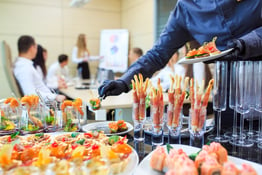
Private dining, corporate events, and group bookings are a great example. Platforms like RestauRent help restaurants showcase their event spaces and connect with businesses and organizations looking for venues. Those larger bookings not only fill seats, but they also introduce new customers who may return for future visits.
Loyalty programs are another proven way to encourage repeat business. Solutions like Paytronix help restaurants create personalized rewards that keep occasional guests engaged and give them a reason to return more often. Over time, those repeat visits can turn first-time diners into loyal, long-term customers.
Expanding Off-Premises Restaurant Sales Beyond Traditional Delivery
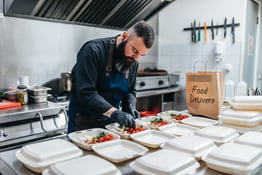
At the same time, I don’t view off-premises restaurant sales as secondary anymore. For many operators, it’s now a core revenue pillar.
What’s changed is not just adoption, but expectation. Consumers increasingly want off-premises experiences that go beyond basic restaurant takeout and delivery sales.
According to the NRA report, interest in expanded offerings is strong:
- 75% would try multi-course meal bundles: This is a direct lever for increasing average order value by encouraging full-meal purchasing rather than single-item orders.
- 72% show interest in meal kits: This extends the restaurant experience into the home while still preserving brand control over preparation and execution.
- 64% would sign up for meal subscription programs: This is where I see the most structural opportunity, because these introduce predictable, recurring revenue into off-premises restaurant sales.
These offerings do more than make ordering convenient. They encourage customers to come back more often and order more consistently. The operators who see the strongest results focus on building lasting customer relationships instead of simply fulfilling individual orders.
That shift is what turns restaurant takeout and delivery sales into something far more durable.
Retail as an Extension of an Increased Restaurant Revenue Strategy
One of the biggest opportunities I see is retail, by turning restaurant brands into products people can take home.
According to the NRA report, consumers say they’d likely purchase the following retail offerings from restaurants:
- 67% of consumers would buy packaged food items like sauces or frozen goods
- 63% would buy cookbooks featuring the restaurant’s recipes
- 61% would buy fresh, uncooked ingredients
- 55% would buy packaged beverages
- 43% would buy branded apparel
What this tells me is that restaurants are increasingly becoming hybrid brands — part hospitality, part consumer product.
From a revenue standpoint, retail matters because it’s not constrained by seating capacity, kitchen output, or delivery logistics.
More importantly, it reinforces the core brand in a way that feeds back into both on-premises restaurant revenue and off-premises restaurant sales.
In practice, retail doesn’t just add a new revenue stream. Retail strengthens the entire ecosystem that supports increasing restaurant revenue over time.
Social Media as a Driver of Restaurant Takeout and Delivery Sales
You can’t really separate revenue growth from how customers find and choose restaurants anymore. Social media has become one of the most influential drivers of demand across both on-premises and off-premises channels.
Consumers are actively using it to decide where and what to eat:
- 78% of adults use social media to discover restaurants
- 73% use it to learn about new foods
- 66% use it to discover beverages
For operators, this means having a strong online presence is no longer optional. Your website, social media channels, and online listings all play a role in helping customers discover your restaurant and take the next step toward ordering or visiting.
Reducing friction is key. Restaurant-focused website providers like Flavor Plate, Anchor, and Sociavore help operators build websites designed to improve local search visibility and make it easier for customers to find menus, place orders, and learn more about the restaurant.
Operators should also make the path from discovery to purchase as simple as possible by connecting ordering options across key digital channels, including restaurant websites, social media, and Google Business Profiles. Platforms like Owner and ChowNow help restaurants create smoother direct-ordering experiences and reduce barriers between customer interest and completed orders.
Social media now plays a much bigger role than marketing alone. It helps create awareness, influence decisions, and drive customers toward both restaurant visits and restaurant takeout and delivery sales.
It shapes intent before the transaction ever happens.
That means operators are now competing on visibility, storytelling, and shareability, as well as food and service.
Bringing It All Together
When I look at the full picture, I don’t see on-premises and off-premises as separate strategies. I see them as interconnected layers of a single revenue model.
The strongest operators I’ve observed are building across three dimensions:
- Experiences that strengthen on-premises restaurant revenue
- Systems that scale off-premises restaurant sales
- Products and extensions that support a long-term increase in restaurant revenue
Each layer reinforces the others. On-premises experiences drive loyalty that fuels off-premises ordering. Off-premises familiarity increases retail conversion. Retail presence strengthens brand recall, which loops back into both.
In my experience, that integrated model is where the real opportunity lies. Not in optimizing a single channel, but in connecting all of them into a unified revenue system.
Stay Ahead of Restaurant Industry Trends
The restaurant industry is constantly evolving, and staying ahead requires keeping up with the latest trends, strategies, and technology shaping the way operators grow.
Subscribe to the weekly Back of House newsletter for insights on increasing revenue, improving operations, and navigating the challenges facing restaurants today.