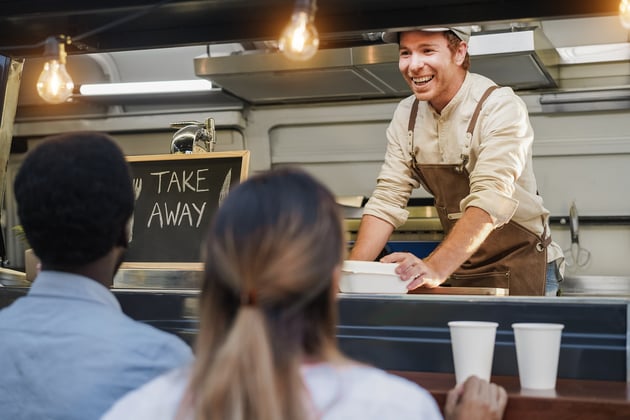
For many food truck owners, the ultimate goal is to expand from the street into a permanent location.
But scaling from a mobile kitchen to a brick-and-mortar restaurant involves more than just finding real estate. It’s a complete shift in how your kitchen operates, your staff functions, and your business grows.
Back of House tech consultants David Wisdom and Dan Durkin share their insights on how to successfully turn a food truck into a restaurant.
What signals that a food truck operator is ready to make the jump to a brick-and-mortar?
These are clear indicators that your food truck business's growth is reaching a point where a permanent location is the next logical step.
David Wisdom: When the truck is consistently busy, lines are predictable, food quality holds up under pressure, and you’re turning people away because of space or time — not hype — those are some great signals you’re ready to leap.
Additionally, when you are tired of fighting weather, permits, breakdowns, and limited prep space, those are also valid signals.
Dan Durkin: When you are consistently hitting the physical limit of your truck’s output, meaning you’re turning away revenue because you simply can’t cook fast enough, that’s a sign.
Likewise, if your current commissary-to-truck logistics have become more expensive and time-consuming than paying rent on a single, unified space, that’s an indicator you’re ready for a permanent location.
Additionally, if you have a proof of concept with your recipes and vibe, receiving great reviews and shares on social media helps.
What fundamentally changes in back-of-house operations when you move from a food truck to a permanent location?
Transitioning to a brick-and-mortar location is more than just extra square footage. It changes the pace, complexity, and scale of your kitchen operations.
David: Everything slows down and speeds up at the same time. You get more space and tools, but you also get more rules, more volume, more people, and more moving parts. You’re no longer “making food,” you’re running a system.
Dan: In a brick-and-mortar, you’ve got a lot more hardware to look after. You move from managing propane tanks and generators to complex HVAC systems, grease traps, waste management, bathrooms, and multi-zone refrigeration.
On the tech side, you’ll be shifting from a simple mobile POS (point of sale) to a fully fleshed-out point of sale that manages multiple prep stations and coursing.
What challenges tend to surprise food truck owners the most after opening a brick-and-mortar?
Even the most experienced food truck operators often underestimate the demands of running a full-service restaurant.
David: Labor costs add up faster than you think. Food waste shows up, equipment breaks more often, and the cleaning never seems to end. A restaurant doesn’t forgive mistakes the way a food truck does.
Dan: Facilities management is a big surprise. When a toilet breaks or a roof leaks, there’s no “driving it to the mechanic.” You’re the landlord and the primary contact for specialized contractors.
Also, in a restaurant, you need a lot more equipment and supplies than in a truck — plates, silverware, glassware, and bulk quantities for everything.
How should operators think differently about kitchen layout and workflow once they’re no longer confined to a truck?
In a food truck, everyone pitches in on every task. A restaurant requires clearly defined stations and a deliberate flow to maximize efficiency.
David: Food should move in one direction: Storage → Prep → Cook → Plate → Serve. If people are bumping into each other, you’re burning time and money.
Dan: Move away from the “single-line” truck flow toward specialized zones: prep, line, expo, and dish. The dish pit is the heartbeat, and if it’s poorly placed, that stalls service. The expo area bridges the kitchen and service team — that’s critical to smooth operations.
How does staffing and labor structure need to evolve when scaling to a brick-and-mortar?
Expanding your operation means evolving your staffing model. What worked on a truck — shared responsibilities and constant multitasking — must shift to defined positions and consistent station ownership in a restaurant.
David: You can’t rely on “all-around” hustle anymore. Clear roles — prep, line, expo, dish — are essential. Training matters more than personality once volume increases.
Dan: Exactly. You need specialists, not generalists. Training becomes intentional because you can’t oversee everything directly. Middle management is necessary because you can’t always be present, so staff need to lead in your absence.
You also need to consider front-of-house training, since customer experience is no longer handled solely by the owner.
What advice would you give around menu size and complexity during this transition?
Expanding your kitchen doesn’t mean expanding your menu recklessly or needlessly. Success comes from smart, scalable offerings.
David: Smaller is smarter. Keep what sells, cut what slows you down. Expansion is earned, not assumed.
Dan: Focus on cross-utilization. Each ingredient should be used in multiple dishes to reduce waste. Keep your standout items, but add supporting dishes like appetizers and desserts to attract repeat customers while staying on brand.

Subscribe to the Operation Station Newsletter
Run tighter operations with practical POS and operational tools, delivered monthly.
How does inventory management change as volume, storage, and purchasing increase?
As your operation grows, so do the stakes for inventory. Bigger storage and bulk buying can be efficient — or disastrous without proper systems.
David: Stop buying “what feels right” and start buying “what the numbers say.” Par levels, usage tracking, proper storage, and ordering schedules become non-negotiable.
Dan: You’ll need broadline distributors for all products — not just proteins and vegetables, but cleaning supplies, containers, and smallwares. Bulk purchasing is more economical but requires proper FIFO (first in, first out) management and training.
What systems or processes should be in place before opening day?
Running a brick-and-mortar restaurant demands more structure and accountability than a truck, and the list of systems is quite long.
David: Inventory tracking, recipe specs, prep lists, cleaning schedules, vendor ordering processes, and a POS that actually matches your operation. If it lives in your head, it’s a risk.
Dan: Preventive maintenance, opening/closing checklists, license reminders, and a digital recipe book. These systems keep operations running smoothly and prevent small issues from becoming big problems.
Food safety is also non-negotiable.
David: Inspectors expect more now. Logs, temperatures, and training matter. Violations stick and cost real money.
What mistakes do you see operators make when trying to scale too quickly?
Even with the best intentions, rushing growth can backfire.
David: Don’t buy too much equipment, hire too many people too soon, expand the menu prematurely, or ignore systems because “we’re busy.” Speed without control breaks businesses.
Dan: Avoid overhiring and don't skip “dry runs” or soft openings. These stress tests are essential for training your team and refining workflow before the full launch.
What decisions tend to have the biggest long-term impact on scalability?
Some back-of-house choices have long-lasting consequences that affect long-term success.
David: Kitchen layout, equipment choices, menu structure, and early systems are the backbone of scalability. Fixing them later is painful.
Dan: Invest in a POS that can grow with you. Interoperability and future-proofing are crucial, so don’t let a bad system block your growth. Think of your tech stack as your operations partner for the next five to seven years.
What’s one piece of advice you wish more food truck operators heard before opening a restaurant?
David: Restaurants reward systems, not hustle. Build structure early, or the business will run you.
Dan: Leave the scarcity mindset behind. Invest in equipment and staff for the long-term success of your food truck to restaurant journey.
Ready To Take Your Food Truck to a Brick-and-Mortar?
By planning strategically, building strong operational systems, and leaning on experienced guidance, you can transform your food truck business growth into a successful brick-and-mortar restaurant.
If you’re ready to scale your operation, a Back of House consultant can provide expert guidance, helping you confidently navigate the leap from food truck to restaurant. Schedule a consultation with Dan or David today to turn your expansion plans into a sustainable, high-performing permanent location.