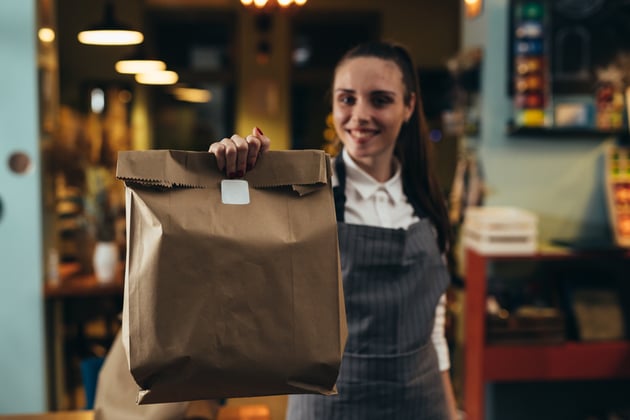
Consumers are opting for delivery more than ever. The number of Americans using delivery services has more than doubled since 2019, according to a recent article from the New York Times. In fact, says the article, three in every four restaurant orders were not eaten inside a restaurant in 2024.
Some Consumers Are Staying Home Whether You Like It or Not
Of course, this is just one of many ways consumer expectations are changing today. But it’s a big one. If you can’t or won’t deliver, you’re missing out on a pretty huge piece of the market.
Clearly, as the demand for (and use) of delivery grows, third-party delivery services like DoorDash, Grubhub, and Uber Eats are reaping the benefits. But so are restaurants that find ways to work the system.
Delivery is driving revenue for restaurants, and it creates opportunities for sales during otherwise slow periods.
So how can we take full advantage of these opportunities? How can we use delivery to drive revenue, especially at a time when third-party delivery fees are going up?
The answer can be found somewhere within a combination of creativity, compromise, and well-chosen technology. I’ll highlight a few ways you can make the rising demand for delivery actually work for your restaurant.
But first, a quick look at just how much third-party delivery apps have changed the restaurant industry in only a few years.
How Third-Party Delivery Apps Transformed the Delivery Landscape
Once upon a time, consumers really only expected delivery services from certain kinds of restaurants – pizza shops, Chinese restaurants, perhaps the local sandwich place. But the pandemic permanently shifted the way consumers view food delivery.
A 2021 article from Eater observed that the pandemic forced restaurant delivery services upon many restaurants that never would have considered them in the past. The article also predicted that there would be no going back once that threshold was crossed.
That proved true. As we mentioned in a recent discussion on how to navigate the third-party delivery market, 81% of operators saw a year over year increase in takeout and delivery orders from 2024 to 2025. This figure tells us that the rise in delivery is not concentrated in any one area of the restaurant industry. It’s happening everywhere.
What began out of necessity during the pandemic has become entrenched as a habit of convenience for American consumers. Today, consumers expect you to deliver, whether you’re a pizza shop or a high-end gastropub.
Opportunity Knocks and Delivers for Restaurants That Adapt
The demand for restaurant delivery isn’t the only thing that’s rising. Sales are rising too, at least for restaurants that are willing to evolve. A recent article from FSR Magazine points out that alongside the massive year over year rise in takeout and delivery orders, for restaurants reporting delivery gains, that gain was an average of 33% in sales.
During a challenging time for restaurants, the “off-premises” dining sector is proving resilient. For restaurant owners who want a piece of this sector, this means recognizing where consumers are and ensuring that your delivery operations are equipped to meet them there.
Evidence from the figures above suggests that a lot of restaurants outside the traditional pizza-and-sandwich shop delivery sphere have spent the last several years learning how to make delivery work for them. And those restaurants that haven’t already implemented strategies for getting onboard are actively looking for the best ways to do exactly that.
According to the 2026 Restaurant Technology Outlook Report from Nation’s Restaurant News (NRN), 19%, or nearly one in every five restaurant operators, said integrating online ordering was their top tech priority.
4 Ways To Make Delivery Work for Your Restaurant
Regardless of how restaurant owners, operators, and chefs feel about delivery, there is an overwhelming sense in the industry that we need to find the best ways to deliver on delivery (pun intended!). And we need to do it without giving up control over the quality of our food or the customer experience.
With that in mind, here are a few tips that can help you boost your delivery sales, adjust your menu to accommodate the growing demand for delivery, and navigate rising commission fees.
1. Think of Third-Party Delivery as a Marketing Expense
One of the things I hear from owners and operators a lot lately is that they’re taking a big hit on third-party delivery service commission fees. It’s absolutely true that the big third-party companies charge significant transaction fees – sometimes as high as 15 to 30 percent!
Obviously, that really cuts into already slim profit margins. Some owners may even opt out of these third-party platforms in favor of commission-free first-party delivery services. That’s an option, and I’ll talk about it in the next section.
But first it’s important to recognize these third-party delivery services for what they are. You are paying for the convenience and the labor, but you’re also paying for visibility on these enormous marketplaces. There is simply no way to compete with the direct exposure to customers that companies like DoorDash and UberEats offer.
So when you consider the cost of commissions for these deliveries, it’s best to think of this cost as part of your marketing budget. In fact, as more consumers gravitate toward options that offer delivery, it could even be worth paying for some premium ad space on these apps. In reality, it’s just about putting your marketing budget where the sales are.
2. Offer Hybrid Delivery
Technically, there are three categories of delivery — first-party, third-party, and hybrid. First-party delivery refers to the old-fashioned way of doing things. Think small pizza shop with its own staff of drivers, a constantly ringing phone, and a restaurant website that sends orders directly to its own POS (point of sale) system. And of course, third-party delivery refers to all the bigger companies we discussed in the section above.
But according to TouchBistro’s 2026 American State of Restaurants Report, 46% of restaurants are taking a hybrid approach with the help of platforms like Cartwheel and ChowNow.
With these hybrid options, you can process delivery orders on your own website or through your phone line, just as you would if you had your own drivers. Then these hybrid platforms actually outsource deliveries to the same third-party delivery services as everybody else.

Subscribe to the Operation Station Newsletter
Run tighter operations with practical POS and operational tools, delivered monthly.
The difference is that they’ve negotiated a flat delivery rate with companies like DoorDash and UberEats. This means you get to pay a flat rate – about $7 to $9 per order – instead of Uber’s roughly 30% fee per delivery. Depending on the size of the order, that’s usually your better option. For instance, on a $50 tab, 30% is $15, so your cost would be roughly half as much with the flat rate.
Not only that, but unlike the third-party providers, hybrid vendors like Cartwheel and ChowNow let you keep your own data. You get to collect all that valuable customer information and use it in your marketing efforts and loyalty program.
Still, it is tough to compete with the exposure you get on the third-party delivery platforms. So with a hybrid approach, you want to list on one or two third-party platforms while using your own channels of communication to encourage customers to order directly from your website.
3. Connect the Dots Between Delivery and Loyalty
Once you select a trustworthy and reliable first-party delivery service, do everything you can to steer customers to that first-party delivery app on your website. Think of third-party delivery as a great way to gain new customers. This is how people find you.
Once you’ve got their attention, though, your first-party delivery app is the best option. And you can do that using your loyalty program to capture and direct that attention.
According to PYMNTS Intelligence January 2026 B2B and Digital Payments Tracker, loyalty programs influence 61% of decisions by delivery customers. Hopefully you’re already working with a loyalty program, whether through your POS system or through an independent provider.
If you don’t have a loyalty program, there are a lot of reasons why you probably should. But for our current discussion, one big reason is that you can use your loyalty program to personalize messaging about delivery promotions and specials.
Let your customers know that they should be using your first-party delivery service and encourage them to do that by making this a slightly cheaper option than the third-party delivery. Share some of those commission fee savings with your most loyal customers, and make sure they know it.
4. Design Dishes for Delivery
Some restaurants are understandably reluctant to offer delivery because of its impact on product quality and customer experience. During the pandemic, some restaurants struggled to adapt. Let’s face it, a medium-rare steak or a piece of Chilean sea bass was simply never intended to be eaten from a foil container after a 40-minute bike ride in a freezer bag.
It’s true that as a restaurant, you don’t have much quality control with third-party delivery, but your brand still suffers if the food arrives cold, mangled, or even half-eaten.
So today, more than five years after the pandemic, it’s no longer about packing up your food and hoping for the best. It’s about creating a menu that is designed for delivery. That may mean only offering some of the items on your menu for delivery, or even creating a new delivery-only menu.
This approach gives you the chance to step back and adjust or invent dishes that still capture the trademark style and flavors of your dine-in menu, but that also hold up better during travel and the passage of time.
Create dishes (and importantly, packaging best practices) where you’re thinking about delivery, not treating it as an afterthought. In a sense, you want to think like a pizza shop. And while you’re doing that, make sure you make careful recipe, portion, and pricing decisions. With some smart, data-driven menu engineering and design decisions, you can find ways to offset at least part of those commission fees.
Delivering With the Right Tech
All kinds of tech-based tools can help you capitalize on the rise in delivery demand. Really, the delivery service apps are just the tip of the iceberg. As you grow your focus on your delivery operations, you’ll want to make thoughtful decisions about staffing, marketing outreach, inventory management, and much more.
I’m happy to walk you through your options. Reach out for your free, personalized consultation and we’ll work together to figure out what makes the most sense for your business.